
Kouvolan Taitaja (Vocational College) developed a social and health care learning environment with 3DBear's support in early 2021. The chosen topic was familiarization with the medicine cabinet, medication identification and distribution, and medication calculations. Taitaja's specialists Hilkka Pentsinen and Suvi Aaltonen designed the content, which 3DBear facilitators Rasmus Borg and Olga Kurikka helped them bring to life in a VR environment. The result was a versatile, interactive learning environment where students can verify their competence in medication handling.
The learning environment was built manually: first, the learning space and tasks were designed. Then, 360-degree photos of the space were taken, along with 2D photos of the objects and medication packages needed for medication distribution. For task instructions, 360-degree videos and audio recordings were produced. The image library was supplemented as the project progressed. Hilkka Pentsinen explains: "When we mapped out the work stages and tools during the planning phase, we didn't realize how beneficial it would be during filming. The shoot went efficiently thanks to the detailed plan — everything had been carefully thought through in advance."
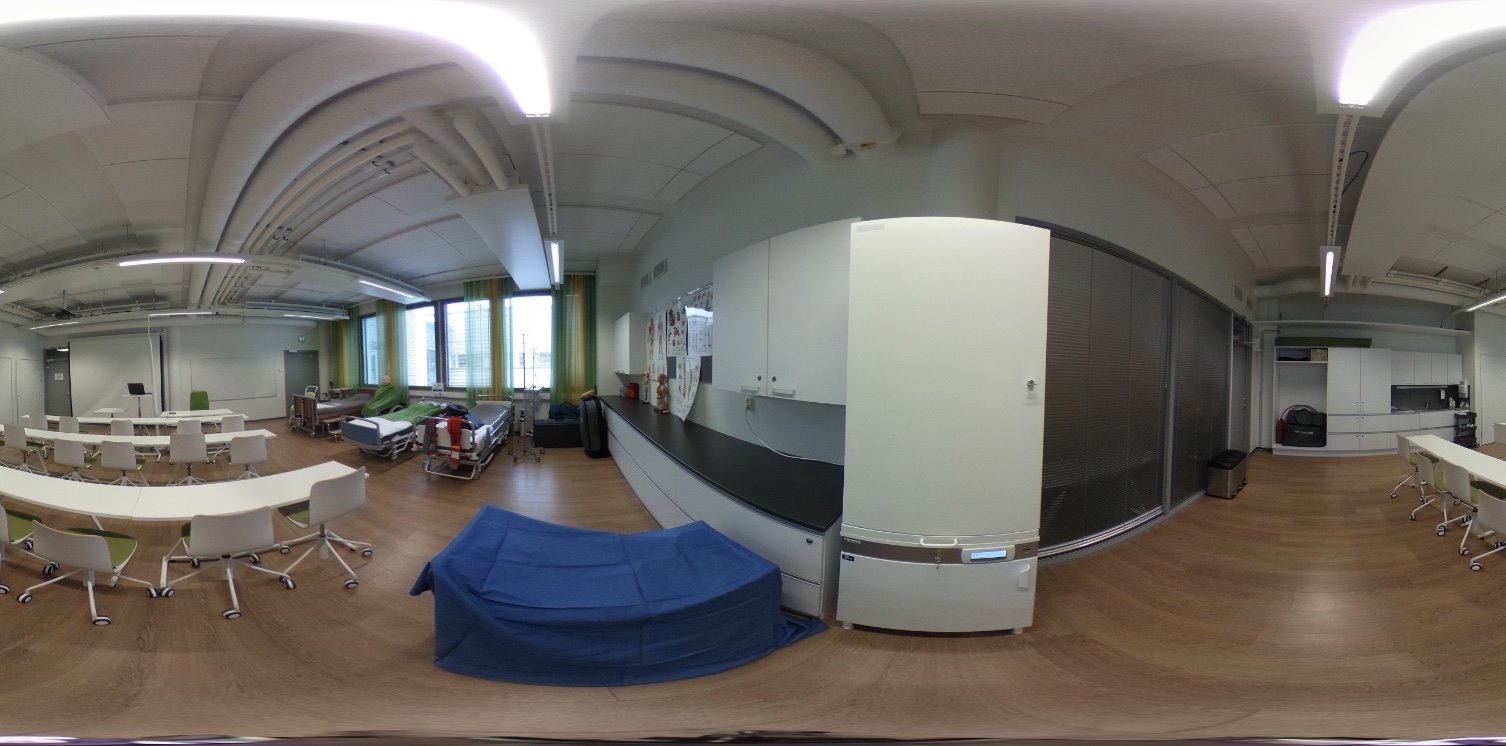
The learning environment begins in a classroom where students can move around as if in a real space. The space is filmed so that the different stages of work can be carried out by rotating the view and interacting with various hotspots. Sound effects and encouraging messages are included.
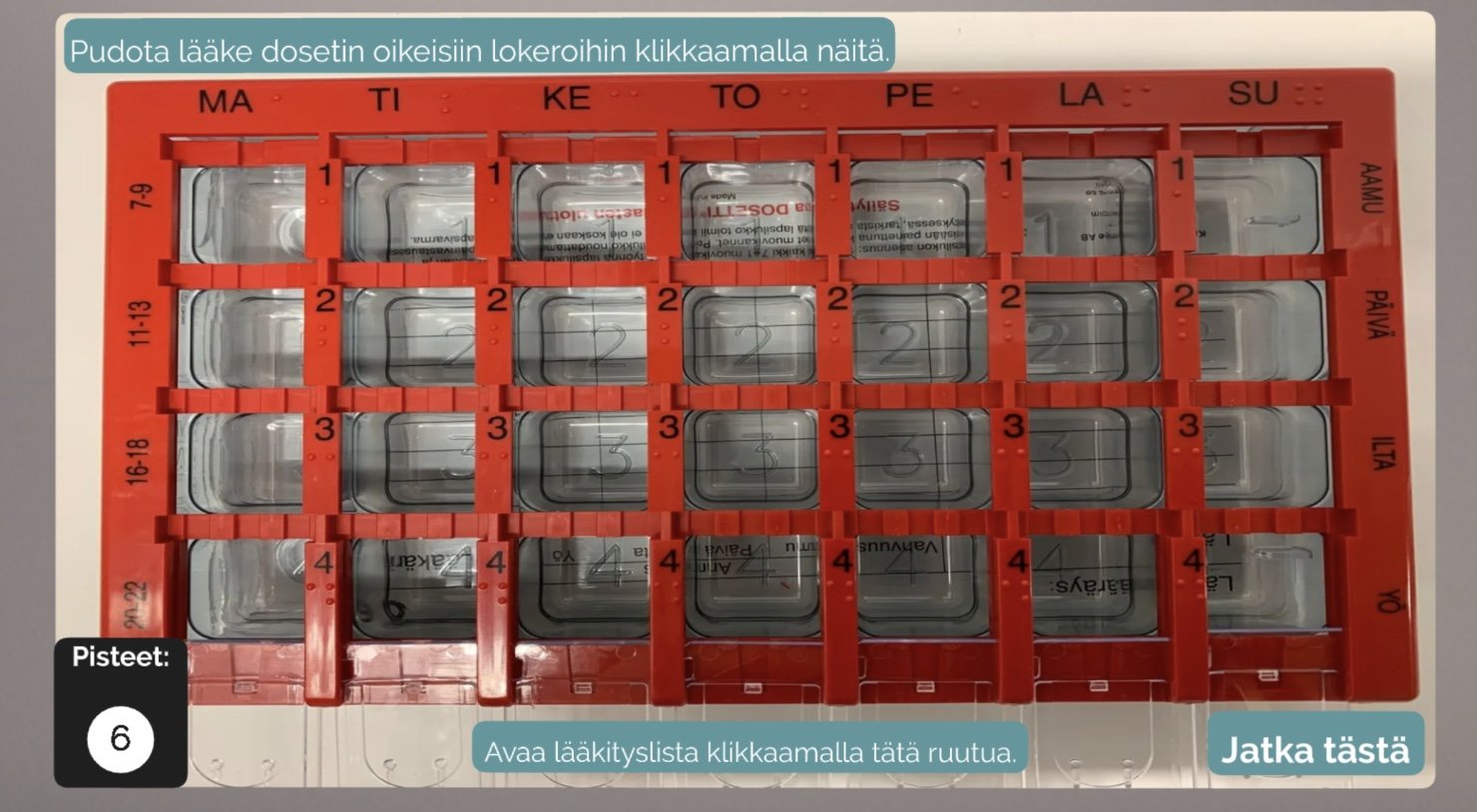
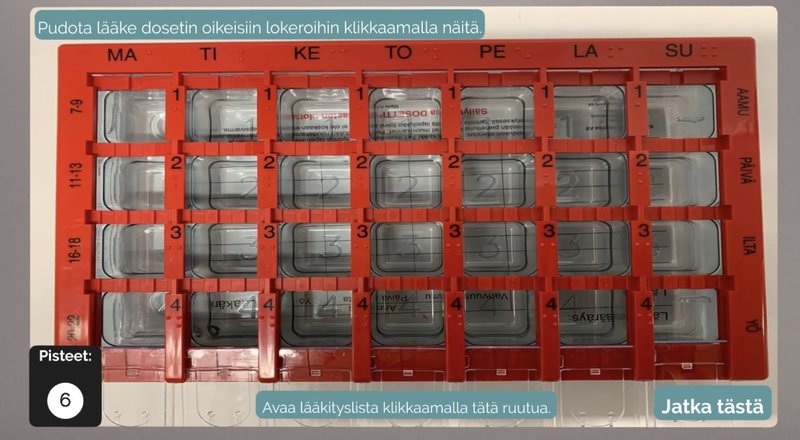
The medicine cabinet is filled one medication at a time. It includes common and less common medications, over-the-counter vitamins, and even veterinary medicines. Medication dosing is also implemented one pill at a time, taking into account days of the week and distribution times. Additionally, the learning environment includes multiple-choice tasks, true/false questions, and calculation exercises. As students progress through the learning session, they can also access supplementary materials through links if their knowledge is lacking. IT specialist Suvi Aaltonen created special URL shortcuts for external links, enabling longer addresses to be neatly integrated into the environment's programming.
The learning environment was tested by students at different stages of their studies. During the spring of 2021, all students studied remotely. According to feedback, the learning environment helped them understand how work is done in practice. Especially during distance learning, students would have had no other connection to their field without the 3D environment. The learning environment brought theoretically learned knowledge within reach and made the work tangible. One student who provided feedback was enthusiastic that virtual learning environments are being created, as they provide better access to the field than traditional teaching methods.
The virtual learning environment is also an excellent tool for teachers. A ready-made learning environment saves up to 100 hours of teacher time per course: tasks and tools are pre-programmed, the experience lasts about half an hour in this case, and scoring is handled automatically by the system. Teachers don't need to spend time preparing the work environment — teaching sessions can focus on the actual substance, and students can immediately try how everything works. Through the virtual learning environment, even the smallest details are covered and passive knowledge becomes activated.
Suvi Aaltonen, Lead Trainer, Taitaja
Hilkka Pentsinen, Welfare Sector Specialist, Taitaja
Olga Kurikka, 3DBear (photo: M. Suokas)