
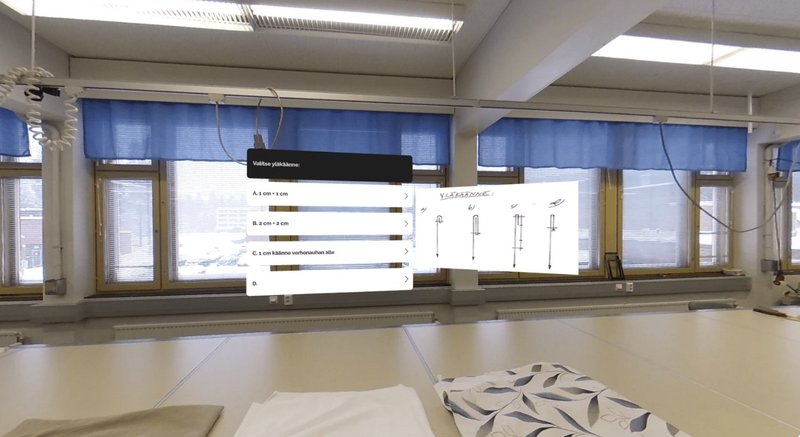
Sedu (Vocational Education Centre) built a VR environment for the interior textiles manufacturing qualification module in textiles and fashion studies, in collaboration with 3DBear. In the VR environment, students can practice the curtain design process from meeting and listening to the customer's needs through to designing and measuring the curtains.
Behind the VR content production was the goal of diversifying learning and offering students the opportunity for independent practice. At Sedu, teachers found the VR content to be an excellent opportunity for students to practice customer service situations and prepare for real-life client encounters in advance. The VR content has been used at Sedu both in guided in-person teaching and in independent distance learning.
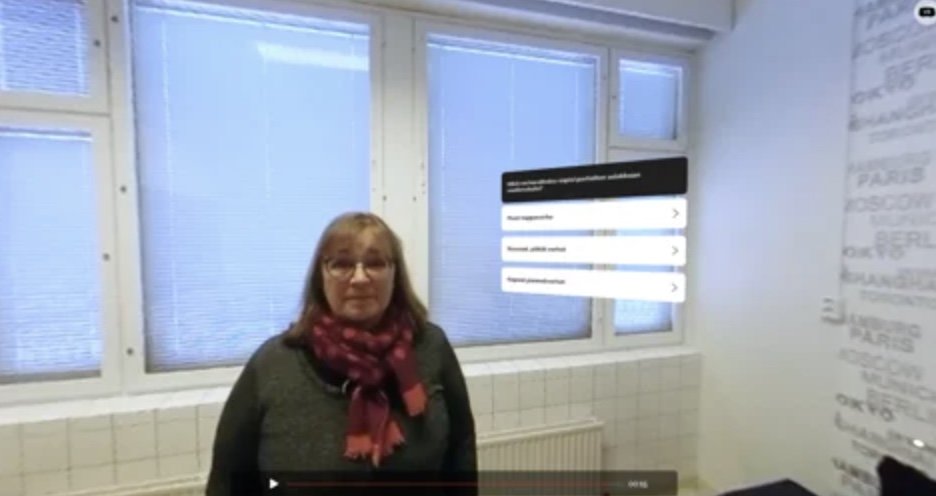
Students practice meeting the customer during the curtain design process.
The VR content was developed following 3DBear's co-development process. Initially, the development felt challenging on Sedu's side, as the virtual learning environment was an entirely new concept. "No one in our department had previous experience with this kind of environment," say the teachers who participated in the project from Sedu. As the process progressed with 3DBear's support, things moved forward smoothly: "3DBear's Rasmus provided excellent support in scripting and building the content, which gave our team a good foundation to continue working on our own," say the Sedu participants. The development process was considered very educational at Sedu — for example, the importance of scripting for a successful outcome became concrete during the process. Sedu's teachers note that practice taught them well and that future projects will be easier. In Sedu's VR content development, the technical expertise of Sedu's eCampus team was combined with the teachers' subject-matter knowledge, and the final result reflects this.
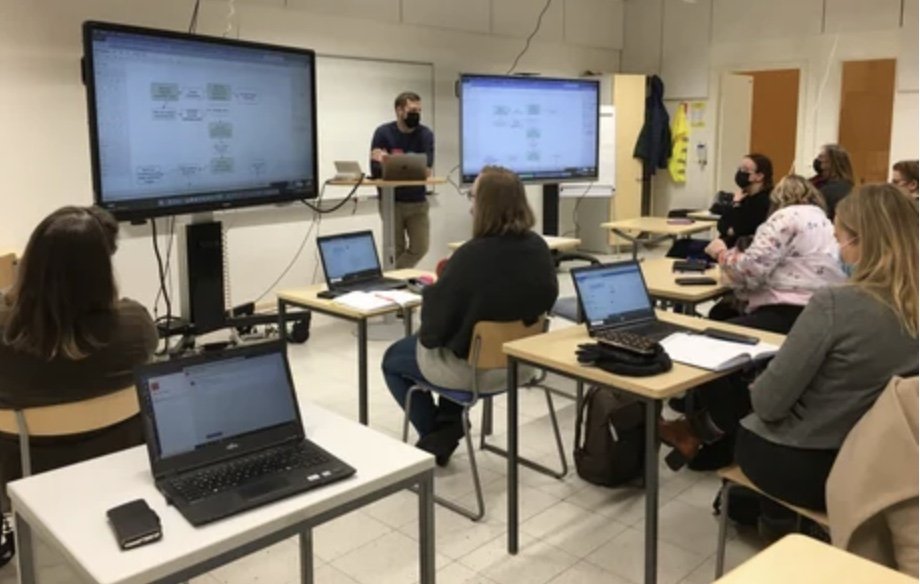
3DBear's Rasmus Borg leading VR content planning for Sedu's staff.
With the VR environment in use, valuable feedback has been gathered to support its further development. The content has been experienced as a welcome change of pace, and the topics taught have stuck with students as they played through the VR content. The content will continue to be developed based on experience. The skills gained in VR content creation during the project also enable staff to continue developing the content independently.
At Sedu, VR development has been carried out at the institution-wide level, including through the eCampus project. "At Sedu, we have actively tested various VR environments and considered their role as eCampus workspaces. A VR roadmap is being built and planned," says Sedu's Development Manager Minna Haasio. Minna notes that Sedu wants to broaden teachers' perspectives on utilizing VR technology in their own fields. At Sedu, VR technology has advanced furthest in driving simulators, logistics, social and health care, and restaurant and catering sectors. Sedu understands well that digitalization is the order of the day, and development continues. Sedu's VR development has also been featured at numerous seminars and workshops.
Authors:
Sedu Lecturers Tuire Karvala, Ulla Åby, and Teacher Jaana Pannula
Sedu Development Manager Minna Haasio