
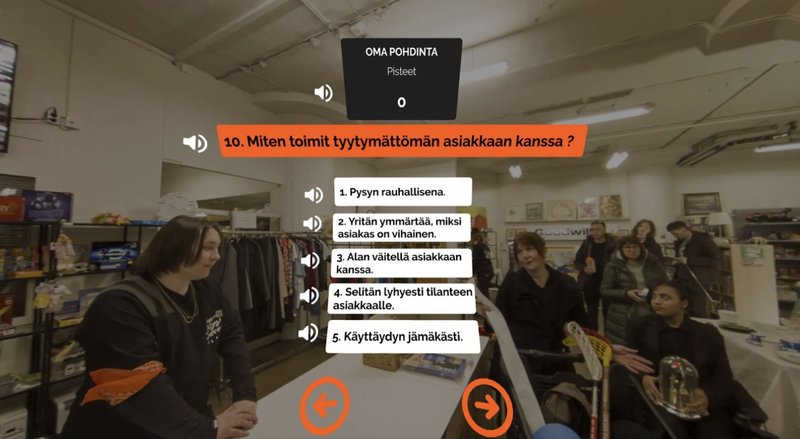
Kiipula Vocational College and Ammattiopisto Live were among the first to develop VR exercises to support special needs students in collaboration with 3DBear. The UFO project was originally driven by the need to provide students with virtual learning environments suitable for practicing practical skills, where they could rehearse new and sometimes challenging or anxiety-inducing situations in advance. Taru Koivisto from Kiipula Vocational College, who led the project, describes the benefits of VR exercises: "Students can prepare for situations, and this reduces anxiety. This makes it easier to master work tasks. None of us can practice challenging or anxiety-inducing situations enough."
As part of the VR development project, the needs of special needs students were extensively explored and how VR technology could address them. Subtitles, audio tracks, symbols, and other elements in the VR environments supported students, while gamification was used to increase engagement. An important part of the project was the extensive student testing carried out by the project team, which provided valuable insights for further content development.
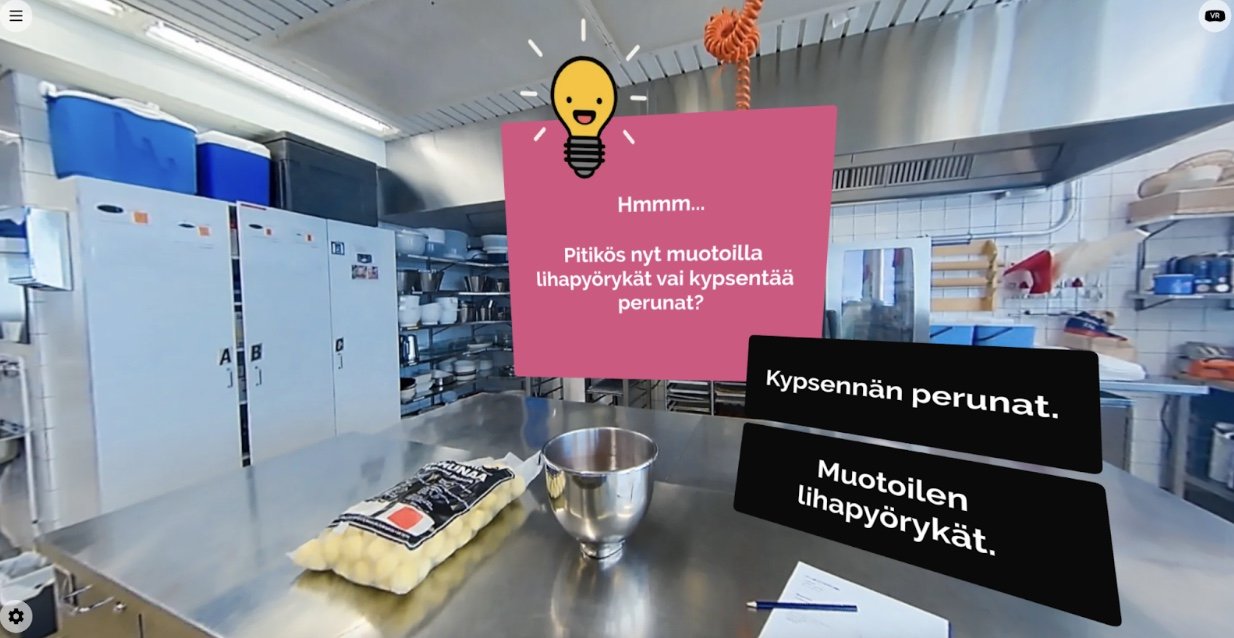
In the catering content, students are broadly motivated through gamified elements. Students learn to plan their workday and the sequence of tasks in lunch preparation.
Plain language in the VR material has been important for students and has received attention. Additionally, neurodiversity coaches and a reading and writing specialist reviewed the content, and based on their feedback, colors, contrasts, and clear navigation were carefully considered when building the VR content. "For some students, reading text is difficult, and in those cases the ability to listen within the environment becomes crucial and helps them progress. The environment must also work when there are difficulties with text size or colors. A virtual environment is right in front of your eyes, so a person with reduced visual acuity might benefit from using VR headsets," says Taru. In the UFO project, piloting and content development proceeded in cycles. Piloting has been of great importance for VR development. "Views are very individual — contrast that's bad for one person isn't a problem for another. We gain understanding of all this through piloting," notes Taru. Minna Kiili, Project Lead at Ammattiopisto Live, states that during the implementation phase, it was essential to consider and choose solutions that would work for as many users as possible.
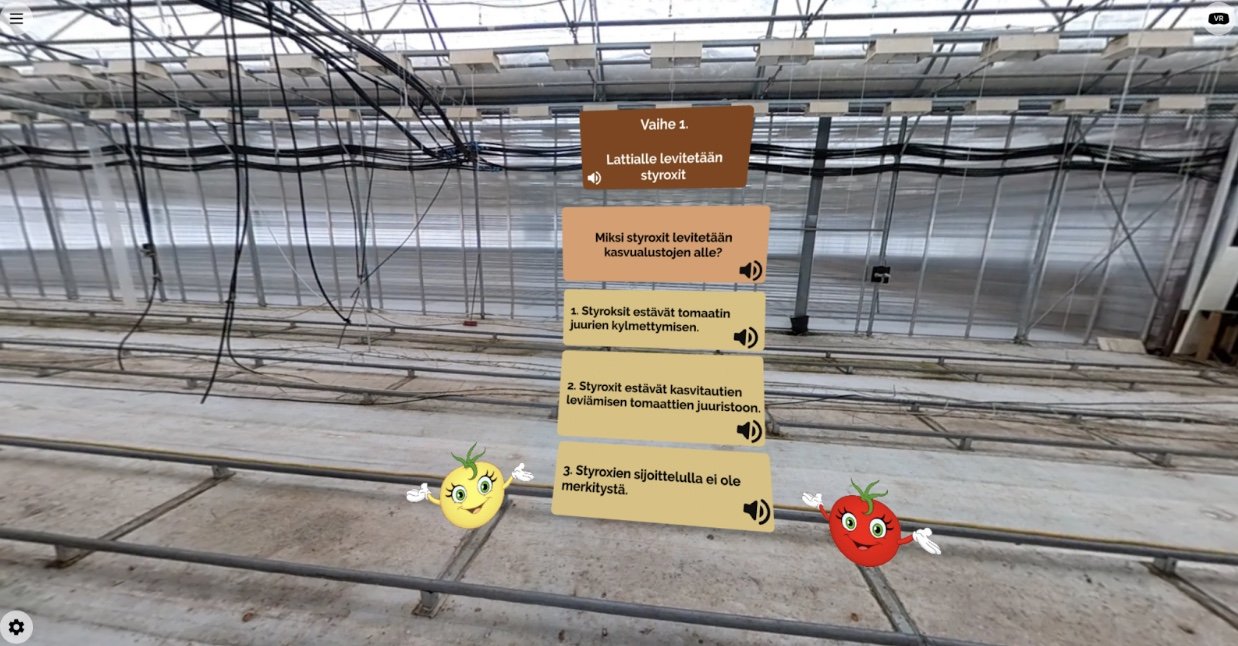
In the gardening environment, the connection between preparing tomato planting and a successful tomato harvest later becomes concrete. This motivates students to complete the preparation tasks and creates a connection to the tomato growing process.
The UFO project developed three different VR environments: for restaurant and catering, customer service, and gardening. All content themes were selected based on student needs. For example, in the gardening sector, greenhouse practice is only possible at the Janakkala campus. When students come from other campuses to Janakkala to practice, the time available is quite limited. With the virtual implementation, students can practice tasks in advance as many times as they want, so that at Janakkala they can get straight to work. "Additionally, students know they're coming to a familiar place because they've been able to practice various work tasks in work environments filmed at the Janakkala campus," notes Taru. In Live's content, students practice workplace interaction situations. "Many young students have no work experience at all, and going to a workplace and meeting new people can be anxiety-inducing. By showing everyday work situations, the aim is to ease the young person's transition into the work environment," says Minna.
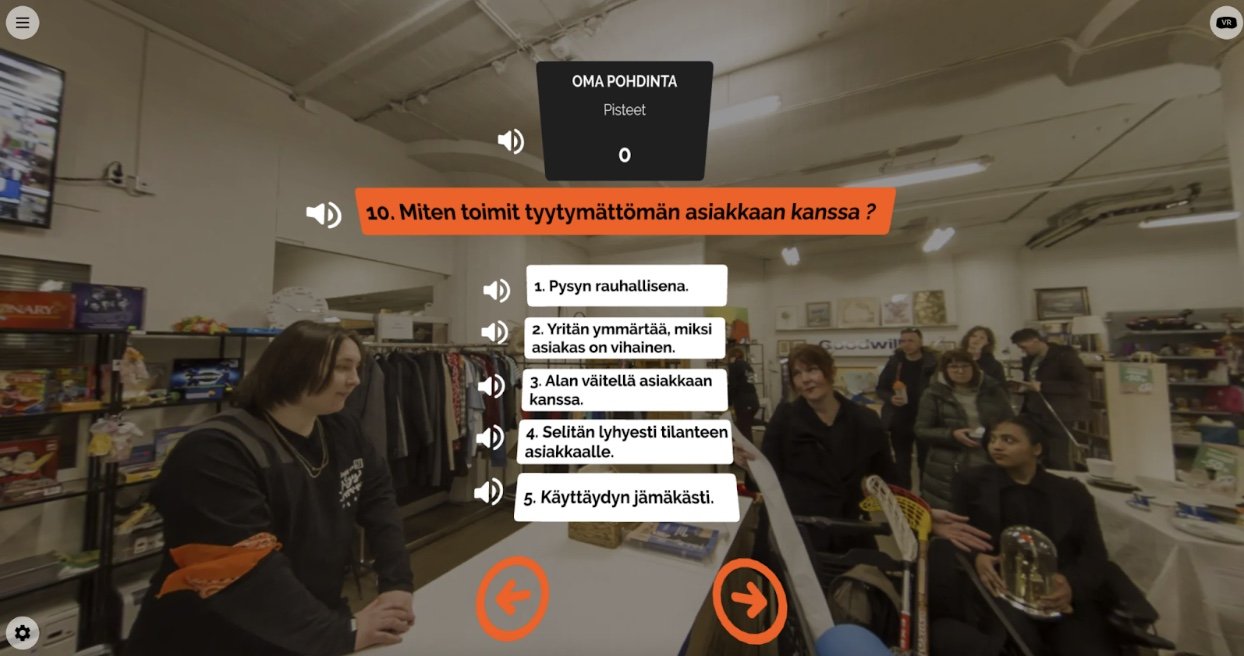
In Ammattiopisto Live's content, students follow the day of a trainee named Matti. Students reflect through exercises on Matti's behavior in different situations and then consider how they themselves would act. The videos primarily feature ordinary situations that recur at many workplaces, but more challenging situations have also been included.
For all content, it was important from the start to use authentic 360° environments rather than coded ones. Students primarily use the content through VR headsets, which has proven effective: "Through VR headsets, certain sensory stimuli are reduced. Students can calm down and focus on the situation without constantly having to observe everything around them — they're in their own bubble, so to speak," says Taru. Minna also emphasizes the immersiveness of the experience through VR headsets: "When the various sensory stimuli of the physical space are removed, the learning material takes center stage and students can focus on it better." At Ammattiopisto Live, using the VR content on a computer is also important: "The material is easy to return to and can be discussed and reflected on together with the teacher and study group," notes Minna.
Taru sees the UFO project as an important first step toward more equitable education: "We're at the frontier as a pioneer pilot project. The ultimate goal is that every student and user would be on the same starting line. Using and experimenting with virtual learning environments is possible for everyone — no one is left behind." Taru considers it an advantage of virtual environments that quality remains the same every time, as it doesn't depend on teaching staff's explanations or the duration of explanations on a particular occasion. Taru sees broad development opportunities in working life and rehabilitation. In closing, Taru says: "More user experience with the finished materials is still needed — development work continues!"
For more information:
Taru Koivisto, Project Manager, taru.koivisto@kiipula.fi
Minna Kiili, Project Lead, minna.kiili@inlive.fi
Read more about the project: hankkeet.kiipula.fi/ufo
Ask 3DBear about project implementation!
Contact us: sales@3dbear.fi